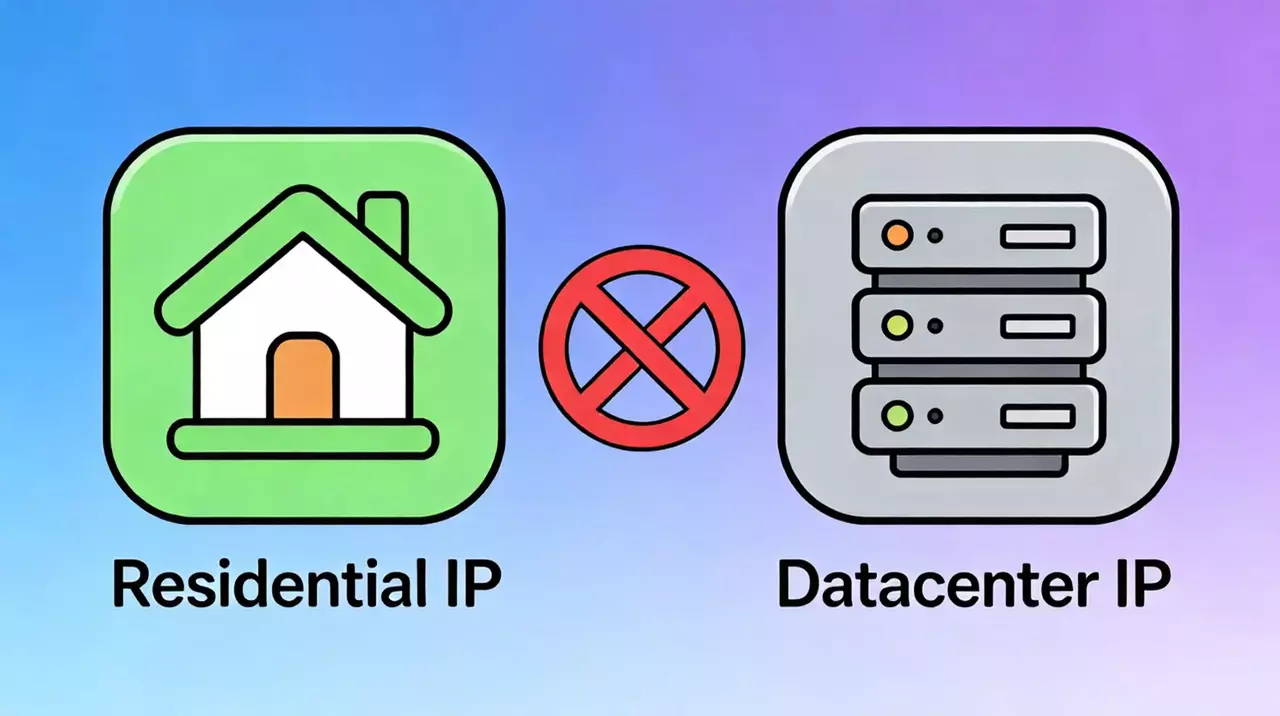


For cross-border e-commerce sellers, daily operations are split into two core areas: 1) “Account Security” for high-value stores and financial accounts, and 2) “Market Research” to understand competitors and target markets.
However, these two business scenarios have completely different, even opposing, network environment requirements.
Many sellers try to use one solution for all problems, often leading to abnormal account logins or distorted research data. Choosing the wrong proxy IP solution is a common “hidden pitfall” in cross-border operations. This article provides an in-depth comparison of three mainstream network proxy solutions to help you make the right choice.

The Two (Different) Network Needs of Cross-Border Sellers
1. Scenario One: Account Security (Core: Stability & High Reputation)
- Business Task: Logging into and managing high-value accounts, such as B2B platforms, independent store backends, seller centers, and payment gateways.
- Network Need: Platform security systems value a “stable login environment” above all. You need a static IP, and that IP’s “reputation” must be extremely high, appearing as a long-term, fixed, and legitimate business location. Frequently changing your IP or using a low-reputation IP is a primary trigger for security flags, which can lead to issues like error 1015 or warnings that “your ip has been temporarily blocked.”
2. Scenario Two: Market Research (Core: Localization & Flexibility)
- Business Task: Viewing competitor pricing, inventory, reviews, and localized displays on public e-commerce sites in different countries.
- Network Need: Platforms display localized content based on the visitor’s IP address. You need the flexibility to switch to local IPs in target countries (e.g., US, Japan, Germany) and emulate a large number of ordinary users to obtain authentic data.
Analysis of Three Mainstream Network Proxy Solutions
Based on these two different needs, let’s analyze the pros and cons of three mainstream solutions.
1. Datacenter Proxy
The Datacenter Proxy is the oldest and most low-cost solution.
- Features: IPs come from a cloud provider’s datacenter, not a real residential network.
- Pros: Extremely fast, inexpensive, and available in large quantities.
- Cons:Lowest IP reputation. Platform security systems can easily identify it as a “datacenter IP,” not a real user.
- Conclusion:Absolutely unsuitable for the “Account Security” scenario. Only use for non-core tasks that require speed but have no IP reputation requirements.
2. Dynamic Residential Proxy
This is a pool of residential proxy IP addresses from real home broadband connections. Many users ask, “what is a residential proxy?” This is the classic answer: a real, rotating IP from an ISP.
- Features: A genuine residential IP address with a high reputation. The IP pool is massive, supports global locations, and is, by nature, a dynamic IP.
- Pros: A perfect match for the “Market Research” scenario. You can emulate thousands of real home users from target countries to efficiently gather authentic, localized data.
- Cons: “Dynamic” is both its strength and weakness. The constantly changing IP is unsuitable for the “Account Security” scenario.
- Conclusion: The best tool for “Market Research.”
3. Static Residential IP
The Static Residential IP is the most advanced solution available today, combining both “high reputation” and “fixed” characteristics.
- Features: The IP originates from a real ISP (Internet Service Provider), making it a high-reputation residential IP. Critically, it is also a static IP, remaining fixed for long-term use.
- Pros: A perfect match for the “Account Security” scenario. It provides your core account with an exclusive, high-reputation, and fixed “home office” address. This is the best way to get a clean IP and maximize the security of your login environment.
- Cons: Because the resources are high-quality and scarce, the cost is relatively higher.
- Conclusion: The optimal solution for the “Account Security” scenario.
Practical Tips: How Should I Choose?
In summary, the most professional cross-border e-commerce operators use a “hybrid approach”:
- Secure Your Core Assets: For your most important, high-value store and payment accounts, equip them with a dedicated Static Residential IP. This is the fundamental configuration for asset protection. When building this security layer, choosing a professional service provider like iphalo, which focuses on providing stable, high-reputation static IP resources, is the first step to ensuring smooth operations.
- Empower Your Market Research: When you need to conduct broad competitor analysis and market research, switch to a Dynamic Residential Proxy to obtain authentic, large-scale localized data.
Common Questions About Proxy Selection
Q: Can’t I just use my “Static Residential IP” for market research?
A: It’s not recommended. First, a Static Residential IP is a valuable, fixed resource. Using it for research that requires mass IP rotation is overkill and very costly. Second, making too many requests from a single IP can also degrade that IP’s reputation over time. Therefore, “dedicated IPs for dedicated tasks” is the most efficient and safest strategy.
Conclusion
There is no “best” proxy IP, only the “most suitable” one for your business scenario. Cross-border sellers should stop the “one-size-fits-all” approach. By carefully configuring your network proxy solutions based on the distinct needs of “Account Security” and “Market Research,” you take a critical step toward professional, compliant, and scaled operations.
Compliance Note: Please ensure all network tools are used for legitimate business operations and market analysis in compliance with all relevant laws, regulations, and platform policies to ensure the healthy development of your business.