


The internet’s underlying architecture is undergoing a quiet but profound transformation. As global IPv4 exhaustion shifts from warning to reality, available IPv4 IP address resources are increasingly scarce, directly driving up costs for the proxy IP industry. Meanwhile, IPv6, seen as the ultimate solution with its near-limitless address space, faces a path filled with network compatibility challenges.
For businesses relying on proxy IP services for e-commerce, social media marketing, or market analysis, understanding the challenges and opportunities of this “generational” migration is key to maintaining business continuity and cost-effectiveness.
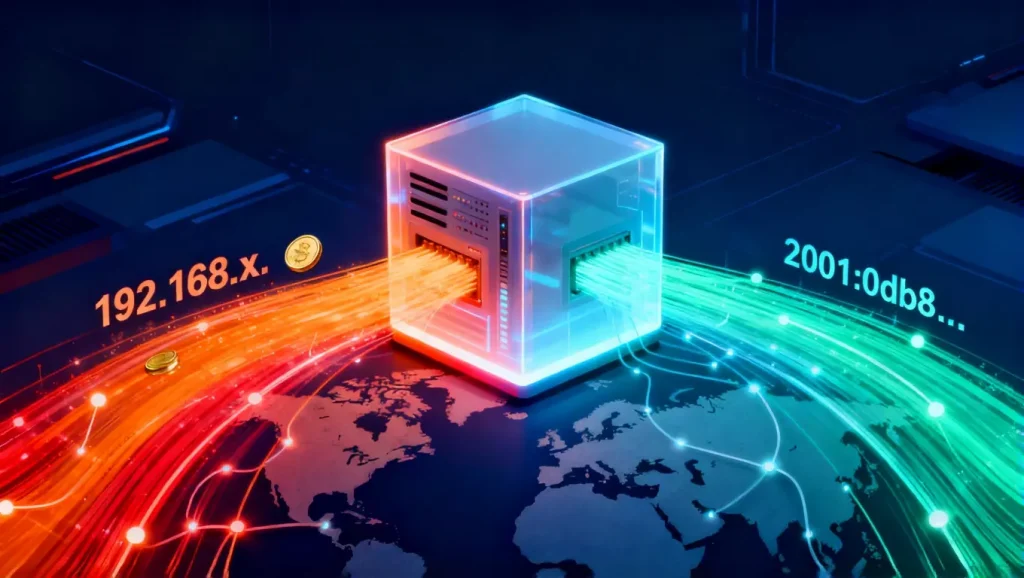
IPv4 Scarcity vs. IPv6 Gaps
The current landscape for the proxy IP industry is delicate. On the one hand, IPv4 exhaustion means that high-quality IP resources, especially rare static residential IP addresses, are seeing rising acquisition and maintenance costs. Businesses are forced to compete for limited and expensive IPv4 IP pools.
On the other hand, IPv6 proxy resources are abundant and low-cost, representing the future. However, the reality is that a vast number of websites and target servers globally do not yet fully support IPv6 access. This technological “gap” leads to a core pain point: network compatibility.
The Dual Challenge for Proxies in a Transitional Era
During the long transition period where IPv4 and IPv6 coexist, users and proxy providers face two primary difficulties.
Challenge 1: High IPv4 Costs and Resource Bottlenecks
For the vast majority of operations, IPv4 remains the “hard currency” for accessing the legacy internet. IPv4 exhaustion means service providers must invest more to maintain and expand their IPv4 address pools. This not only limits large-scale operations but also keeps the price of premium resources, like static residential IP addresses, high.
Challenge 2: The Network Compatibility Challenge of IPv6
An IPv6 proxy is great in theory, but “usable” and “effective” are two different things. If a company is conducting compliant data collection (i.e., adhering to robots.txt protocols and relevant regulations) and its target website only supports IPv4, using a pure IPv6 proxy will result in a connection failure. This network compatibility “gamble” is the main reason businesses are hesitant to switch protocols.
Crossing the Divide: The “Dual Stack” IP Pool as the Solution
Faced with network compatibility challenges, the proxy IP industry’s solution is not an “either/or” choice, but a test of a provider’s technical depth: “fusion and intelligence.”
A professional, future-ready IP pool must be “Dual Stack” or “hybrid”—meaning it contains massive reserves of both IPv4 and IPv6 resources and possesses intelligent routing and protocol translation capabilities.
Therefore, when businesses evaluate a network proxy service, they shouldn’t just look at a single protocol but rather examine the comprehensive capabilities of the provider’s “Dual Stack” IP pool. This includes the scale of its IP pool, the purity of the resources (i.e., a clean ip), and its ability to sustainably supply scarce resources like static residential IP addresses. These foundational strengths are precisely the bedrock upon which professional providers, such as IPHALO, build their service reliability.
Frequently Asked Questions (FAQ)
Q: Can my current business get by using only an IPv4 proxy?
A: In the short term, if your target websites only support IPv4, this is viable. But considering long-term costs and future development, as IPv4 exhaustion worsens, prices will continue to rise. Choosing a provider with a large-scale, high-compatibility “Dual Stack” IP pool is the more forward-thinking strategy.
Q: Will using an IPv6 proxy affect my connection speed?
A: No. Connection speed primarily depends on the proxy server’s infrastructure, network bandwidth, and routing quality, having no direct relationship with the IP protocol version itself. An IPv6 proxy built on a high-quality network foundation can achieve the same level of speed and stability as a premium IPv4 network.
Conclusion: Choosing the Right Partner in an Era of Change
IPv4 exhaustion and IPv6 adoption are irreversible trends in the proxy IP industry. For enterprise users, rather than hesitating between the two protocols, the better choice is to select a partner that can provide a powerful, flexible, and comprehensive IP pool. Mastering the ability to navigate this technological shift is the only way to stay ahead in future global operations.
Compliance Notice:Please ensure all your data collection and network activities are conducted in compliance with relevant laws, regulations, and the data policies of target platforms.