

It’s the middle of a long study session or a quiet break at work. You click a YouTube link, expecting a video, but instead, you get the gray screen of death: “This site is blocked by your administrator.”
Network administrators at schools and offices are getting smarter. They don’t just block the domain youtube.com; they use sophisticated filters to inspect traffic, throttle VPNs, and restrict bandwidth.
Most people try to get around this with free web proxies or sketchy browser extensions, only to end up with 240p video quality, endless buffering, or a computer full of malware.
If you want to watch HD content smoothly—without the admin knowing—you need a better method. This post explains exactly how modern firewalls catch you, and the reliable ways to bypass them in 2026.
The Tech Behind the Block: Why Simple Tricks Fail
Before we fix it, you need to know what you are fighting against. Years ago, you could just type the URL into Google Translate to watch videos. That doesn’t work anymore because admins now use Deep Packet Inspection (DPI).
Here is why the old methods are dead:
- The “Free Proxy” Site: These are public websites where you paste a URL. The problem? They are overcrowded. Sharing bandwidth with 5,000 other students means your video will buffer every 5 seconds. Plus, schools usually block the proxy sites themselves within days.
- The “Tor Browser” Myth: You might hear people suggest using Tor (The Onion Router). Don’t. Tor is built for anonymity, not streaming. It bounces your signal through so many nodes worldwide that watching a 1080p video is practically impossible.
- The “Standard VPN” Trap: Schools subscribe to lists of known VPN IP addresses (like Nord or Express) and blacklist them. If you try to connect, the VPN simply won’t handshake.
To beat a modern firewall, you need a connection that looks boringly normal—a IPhalo secure network foundation that mimics legitimate residential traffic.
Method 1: The “Emergency” Fix (Mobile Hotspot)
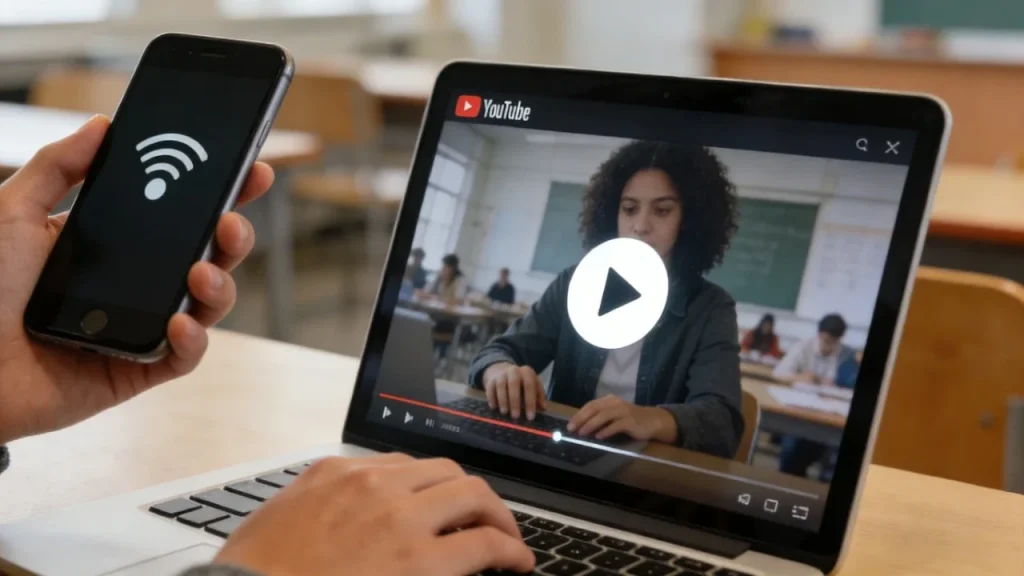
If you just need to watch a 2-minute clip and don’t care about data usage, the fastest way is to disconnect from the school Wi-Fi entirely.
- How to do it: Turn off Wi-Fi on your phone or use your phone as a “Personal Hotspot” for your laptop.
- The Downside: This bypasses the school network completely, but 4K video eats data aggressively (approx. 7GB per hour). It’s not a long-term solution, and some school buildings act as “Faraday cages” that block cell signals.
Method 2: The “Pro” Fix (Residential Proxies)
If you want to watch a 2-hour podcast or a playlist in high definition without burning your mobile data plan, you need to tunnel through the school Wi-Fi using a Residential Proxy.
Unlike a standard VPN that shouts “I am hiding something,” a Residential Proxy makes your traffic look like it’s coming from a regular home ISP (like Comcast or Verizon).
VPN vs. Residential Proxy for Streaming
| Feature | Standard VPN | Residential Proxy (IPhalo) |
| IP Type | Datacenter (Easily flagged) | Residential (Real ISP) |
| Detectability | High (DPI can spot VPN protocols) | Low (Looks like normal HTTPS) |
| Streaming Speed | Variable (Throttled by school) | High (Buffer-free) |
| Unblock Success | 50/50 (Often blocked) | 99% (Hard to block) |
Why this is the best method:
- Undetectable: The school firewall sees your connection as standard web traffic to a residential IP. It doesn’t trigger the “VPN Block” alarm.
- Speed: Premium residential IPs offer dedicated bandwidth, allowing for buffer-free HD streaming even during peak hours.
- Region Unlocking: If a video is “Not available in your country” (common with music videos), you can choose a proxy in a region where it is allowed.
Method 3: Browser Extensions (Use with Caution)
There are thousands of “YouTube Unblocker” extensions on the Chrome Web Store. They work by rerouting your browser traffic through a proxy server automatically.
- Pros: Easy to install (if the admin hasn’t blocked the Chrome Web Store).
- Cons:Security Risk. Most of these free extensions are effectively spyware. They sell your browsing history to advertisers to pay for their servers.
- Verdict: Only use extensions from trusted paid providers, or configure a manual proxy in your browser settings.
Bonus: For YouTube Creators & Marketers
If you are reading this, you might not just be a student. You might be a social media manager running 10+ YouTube channels.
If you log into 10 different Google accounts from the same IP address to upload videos or comment, YouTube’s algorithm will flag you as a “Bot Farm.” Your views will be frozen, and your channels might be “Shadowbanned.”
The Solution:
Use an antidetect browser paired with Static Residential Proxies.
- Assign IP A to Channel 1.
- Assign IP B to Channel 2.
- This isolates your accounts. If one channel gets a copyright strike, the others remain safe because YouTube sees them as completely different users.
Troubleshooting: What If It Still Won’t Load?
Even with a proxy, sometimes things glitch. Here is a quick checklist:
- Clear Cache: Your browser might be remembering the “Blocked” page. Clear your cache or open an Incognito window.
- Disable “QUIC” Protocol: In Chrome (
chrome://flags), disable the Experimental QUIC protocol. Sometimes firewalls use this to sniff out proxy traffic. - Check DNS: If the proxy connects but YouTube says “DNS Error,” manually set your computer’s DNS to
1.1.1.1(Cloudflare) or8.8.8.8(Google).
Summary
Getting YouTube Unblocked isn’t just about accessing the site; it’s about the quality of the experience.
- Avoid: Tor Browser (too slow) and sketchy “Free Web Proxies” (unsafe).
- Use: Mobile Data (for quick clips) or a Residential Proxy (for long sessions and creators).
Stop settling for 360p videos that pause every ten seconds. Upgrade your connection to something that can handle the load.
Watch YouTube without limits and take back your internet freedom.
FAQ
Q: Can I unblock YouTube on a school Chromebook?
A: Chromebooks are locked down tight. However, if you can install an Android app (like a proxy manager) or a browser extension that supports custom proxy configuration, a residential proxy will work.
Q: Why is “Restricted Mode” locked on?
A: This is a network-level setting enforced by the school’s DNS. You cannot turn it off in YouTube settings. The only way to disable it is to route your traffic through a proxy that uses a different DNS server, bypassing the school’s filter entirely.
Q: Is it illegal to unblock YouTube at school?
A: It is generally not illegal (you aren’t hacking a bank), but it likely violates your school’s “Acceptable Use Policy.” You won’t go to jail, but you could get detention. Use these methods responsibly.