

For businesses engaged in automated data collection, competitive intelligence, or ad verification, encountering Cloudflare Error 1020 is a specific type of infrastructure failure.
Unlike a 404 (Not Found) or a 503 (Service Unavailable), Error 1020 is a deliberate rejection. The message “Access denied” indicates that while the server is functional, the Cloudflare Web Application Firewall (WAF) has flagged your request as a violation of its security policies.
While developers often look for bugs in their scraper code or headers, the root cause is frequently simpler and harder to fix with code alone: Network Identity. Specifically, the reputation of your IP address and its Autonomous System Number (ASN) classification often triggers the block before the request even reaches the server.
The Mechanics of a Block: Why You Were Rejected
Cloudflare allows website administrators to set firewall rules based on specific criteria. When you see Error 1020, your request matched a “Block” rule.
In the context of automated traffic, three specific filters are responsible for the vast majority of these errors:
- ASN Classification (The “Datacenter” Flag)
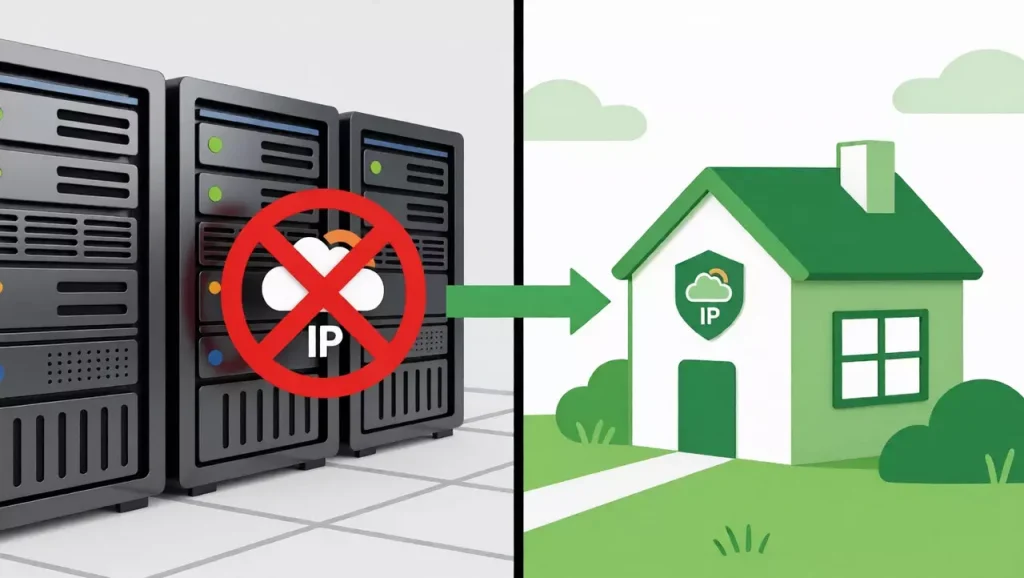
This is the most common trigger for commercial scrapers. Cloudflare categorizes IP addresses based on their ASN. IPs from AWS, Google Cloud, or DigitalOcean are tagged as “Hosting” or “Datacenter.” Administrators often enable a single toggle: “Block all traffic from Datacenter ASNs.” If you are using a standard datacenter proxy, your request is blocked instantly based on this tag. No amount of header optimization or delay randomization will bypass this, as the rejection happens at the network layer.
- IP Reputation Scoring
Cloudflare maintains a global threat intelligence network. If you use a shared public proxy, it is highly likely that other users have utilized that same IP for malicious activities (DDoS, spam, or credential stuffing). Once an IP’s “Threat Score” exceeds a certain threshold, the WAF automatically serves the Error 1020 challenge page, regardless of the intent of your specific request.
- TLS Fingerprint Mismatch
Beyond the IP, Cloudflare inspects the “Hello” packet of the TLS handshake. If your bot claims to be Chrome 120 (via User-Agent) but its TLS handshake parameters (JA3 fingerprint) match a Python script or a generic HTTP library, the discrepancy triggers the WAF.
Infrastructure Remediation: Bypassing the ASN Filter
Since the primary trigger for Error 1020 is often the “Datacenter” classification of your IP, the solution requires a fundamental shift in network infrastructure.
The Role of ISP Proxies
To bypass ASN-based blocking, you must utilize ISP Static Residential Proxies.
- ASN Legitimacy: Unlike datacenter IPs, ISP proxies are assigned by genuine consumer internet service providers (e.g., Verizon, AT&T, Comcast). In Cloudflare’s database, these are tagged as “ISP” or “Residential.”
- The “Whitelisted” Status: Traffic originating from these IPs is treated as organic user traffic. Firewall rules designed to block “server farms” do not apply to these connections.
By integrating a high-quality residential proxy service, you effectively change your network identity from a “server” to a “home user.” This is the foundational step in resolving Error 1020. Without a compliant ASN, downstream optimizations (like cookie management) are futile.
The “IP Plus Fingerprint” Strategy
It is critical to understand that while a high-quality IP is necessary, it is not always sufficient on its own for advanced targets.
- The Foundation (IP): Using a clean ISP proxy solves the ASN blocking and Reputation issues. This gets you past the “front door.”
- The Verification (Fingerprint): Once the IP is accepted, the WAF may check your browser headers. Ensure your automation tools maintain consistent TLS fingerprints and valid User-Agents.
Note: Using a high-quality ISP IP with a broken fingerprint is better than using a datacenter IP with a perfect fingerprint. Cloudflare checks the IP first.
Frequently Asked Questions (FAQ)
Q: Can I fix Error 1020 by clearing my cookies?
A: Rarely. If the rule blocking you is based on IP reputation or Geo-location, cookies are irrelevant. Clearing cookies only helps if the ban was triggered by a specific corrupted session token.
Q: Why do VPNs also trigger Error 1020?
A: Most commercial VPNs use shared datacenter IPs. They suffer from the exact same “ASN Blocking” and “Bad Reputation” issues as cheap proxies.
Q: Is the Error 1020 block permanent?
A: It depends on the admin’s settings. However, if the block is based on your IP type (Datacenter), it is effectively permanent until you switch to a Residential/ISP IP.
Conclusion: Aligning Infrastructure with Compliance
Cloudflare Error 1020 is not a bug; it is a security feature working as intended. For businesses, it serves as a signal that your current data collection infrastructure lacks the necessary trust signals.
To ensure business continuity and access to public data, migrating to an ISP-based residential network is the industry standard.
Eliminate network-level blocks and secure your access. Start your optimized journey here and deploy the compliant infrastructure required to navigate modern WAF protections.